
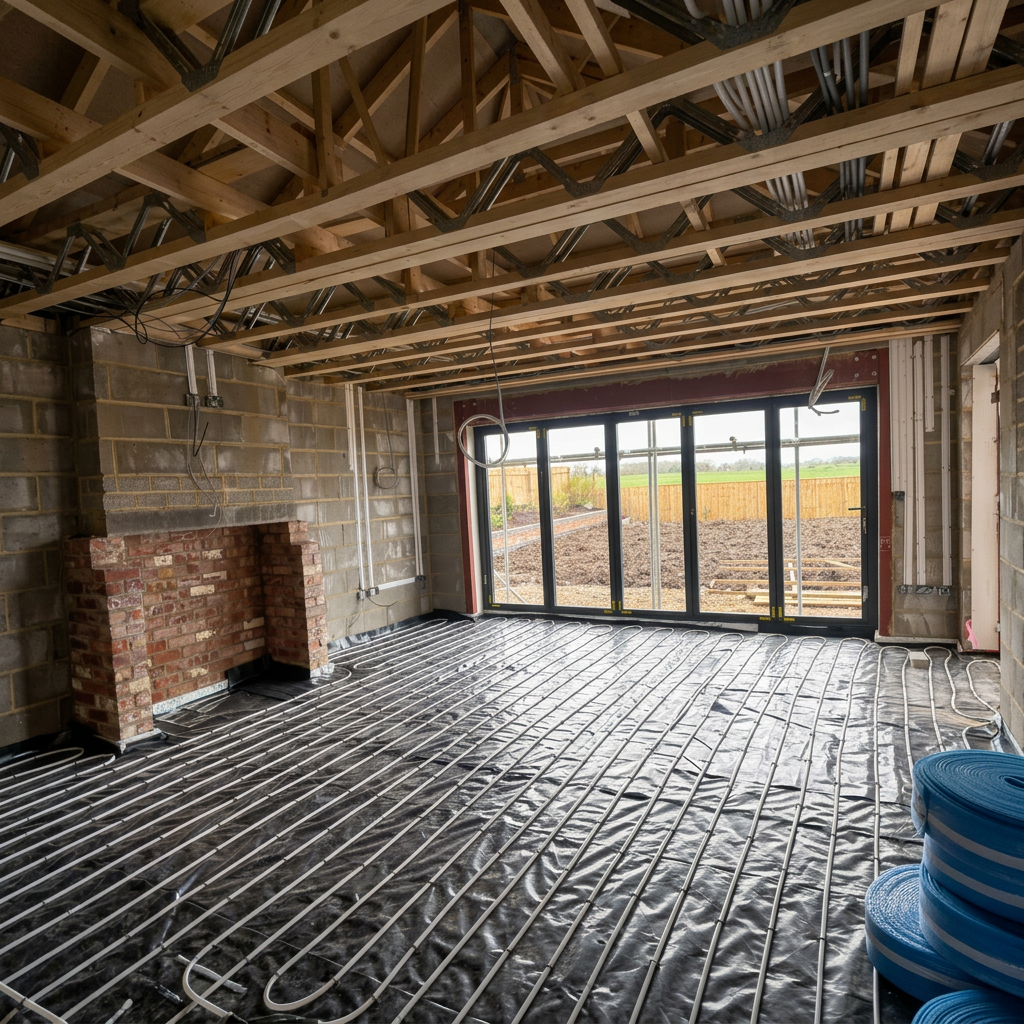
Wet underfloor heating pipework laid in an open-plan North East home
Service · North East England

Underfloor Heating Installationin Darlington and the North Eastwet and electric systems

Whole-house wet systems, retrofit low-profile overlays, and electric heating mats for bathrooms and kitchens — designed for low flow temperatures, perfectly balanced, and ready for heat pumps and modern A-rated boilers from day one.

Heat-pump-ready design · Manufacturer-trained · 25-year pipe warranty

25 yr
Pipe & manifold warranty
Heat-pump
Ready by design
18 mm
Low-profile retrofit option
Room-by-room
Zone control as standard
Full design
CAD layout before quote
Service Overview

What you need to know

What it is

Underfloor heating (UFH) delivers low-flow-temperature heat through pipes (wet systems) or electric heating elements embedded in the floor. The whole floor becomes the emitter, giving even radiant warmth with no cold spots and no radiators on the wall.

Who it's for

Anyone building, extending or fully refurbishing; homeowners pairing UFH with a heat pump (UFH is the ideal low-temperature emitter); families fitting solid wood, tile or polished concrete floors; and bathroom or kitchen refurb owners wanting a warm tiled floor under bare feet.

When you need it

During new-build first-fix, during extensions (existing floor lifted), during a major refurbishment, during a kitchen or bathroom replacement, or when fitting a heat pump and the existing radiators are too small.

Why professional matters

Radiators heat a room by convection — hot air rises, cold air falls, dust circulates and the top of the room is always 2–3°C warmer than your feet. UFH heats by radiation — every surface is the same temperature, the room feels warmer at a lower air temperature, and the system runs at flow temperatures heat pumps love (35–40°C).

What it costs to delay

The real consequences of putting it off

UFH is hidden under the floor. Mistakes are buried for the next 25 years. Here's what goes wrong with poor installs:

Cold spots and uneven heat

Without proper CAD design and pipe spacing calculations, some rooms run cold while others overheat — and there's no fixing it without lifting the floor.

Damaged pipes

Untested manifolds, kinked pipes during screeding, missing pressure tests during construction — these turn into leaks under £200 m² of stone tiling.

Heat-pump incompatibility

UFH designed for 55°C gas-boiler operation cripples a heat pump. Pipe spacing must be tighter, manifolds matched, and zoning rethought. Most DIY/cheap installers don't know this.

Slow response

Wrong floor build-up (no insulation under the screed, wrong screed depth, wrong floor finish) means the room takes 4 hours to warm up instead of 45 minutes.

Tripping electrics

Electric UFH installed without proper RCD protection, undersized cable or unsealed terminations is a fire and shock risk — and unlawful.

Common mistakes we fix

Buying online and self-installing

DIY kits look cheap until the first leak, the first cold spot, or the first cracked tile. There is no warranty on a self-installed system.

Treating UFH as a top-up

UFH on a poorly insulated floor can never out-pace the heat loss. We always specify insulation and floor build-up as part of the design.

Skipping the commissioning balance

An unbalanced manifold sends most of the flow to the easiest loop and starves the rest. We balance every zone with a flow meter on commissioning day.

Our Process

A predictable, engineered process

  1. STEP 01

    Survey & floor build-up review

    We inspect the substrate (concrete, joisted, screed), measure floor heights, agree the floor finish and check insulation. Heat loss calculated per room.

  2. STEP 02

    CAD layout & quote

    You get a full pipe-layout drawing per room, pipe centres, loop lengths, manifold position and zone strategy — alongside a fixed-price quote.

  3. STEP 03

    First fix (insulation & pipework)

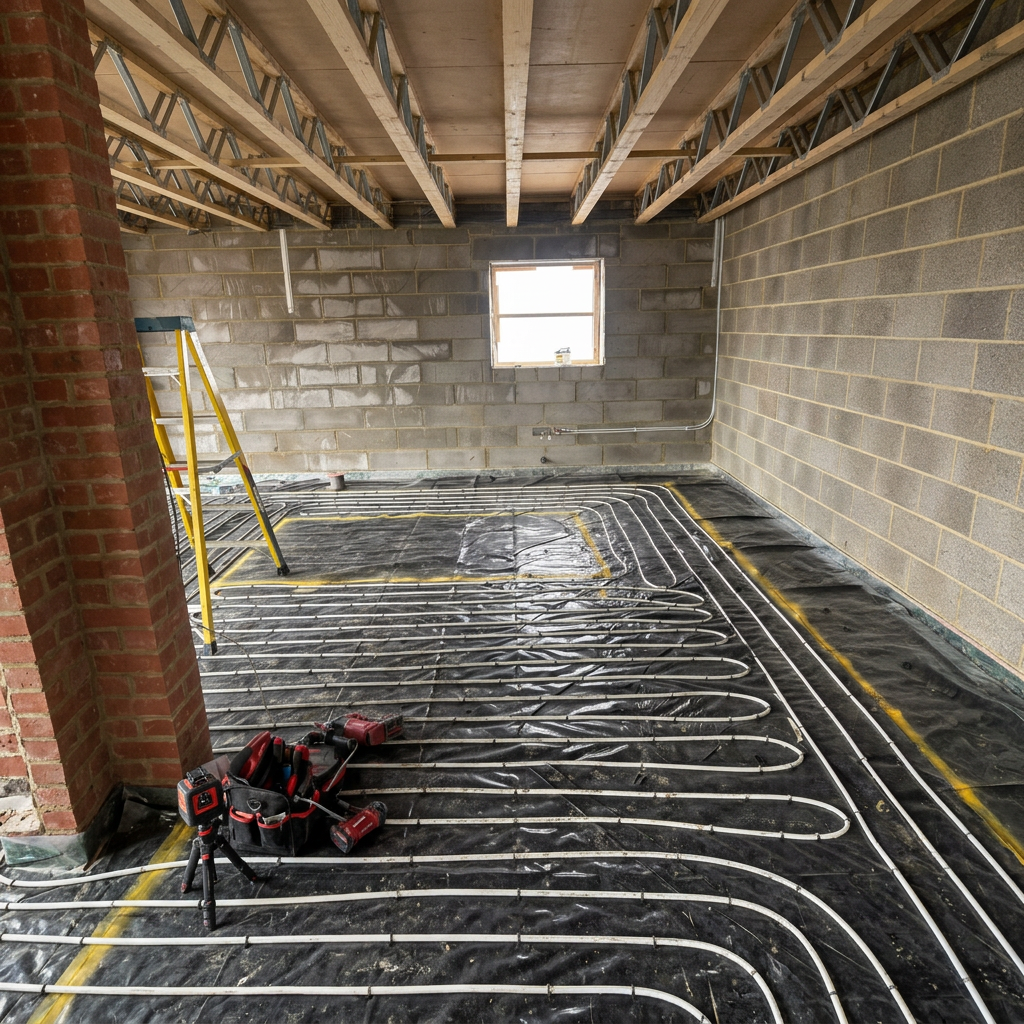
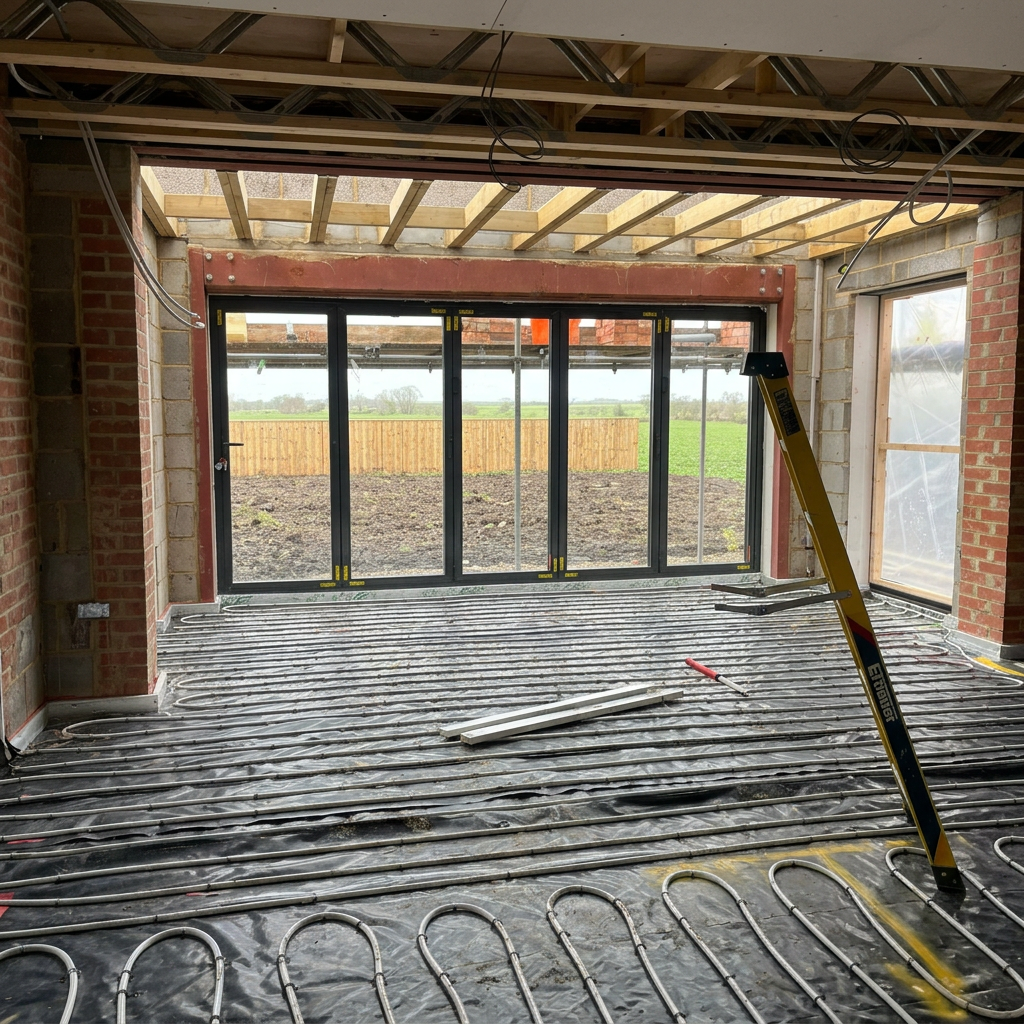
    Insulation board (PIR or EPS), edge expansion strip, pipe clipped to design centres, manifold mounted, full pressure test held at 6 bar.

  4. STEP 04

    Screed / overlay & second fix

    Liquid screed or 18 mm low-profile overlay poured by approved partner. After cure, we connect manifold, fit actuators, wire controls and run leak/pressure test again.

  5. STEP 05

    Commission, balance & handover

    Slow warm-up curve to protect screed, then full flow-balance, individual zone test, smart thermostat pairing, and a 25-year pipe warranty registration.

Why it pays off

Outcomes you can measure

Even, radiant warmth

No cold floors, no hot ceilings, no draughts. Comfortable at 19°C instead of 21°C — saving 6–10% on heating bills.

Heat-pump ready

Designed for 35–40°C flow temperatures, UFH unlocks the best COP from any ASHP — a 20% efficiency gain over upsized radiators alone.

Free wall space

No radiators. Furniture goes where you want it. Kitchens and bathrooms in particular look cleaner.

Silent

No banging pipes, no clicking valves, no airlocks. UFH runs invisibly and silently.

Allergy-friendly

Radiation rather than convection means less dust circulation — a real benefit for asthma and allergy sufferers.

Faster, warmer bathrooms

Electric UFH in bathrooms warms a tiled floor in 30 minutes. The single most-loved upgrade in any refurb.

The Engineering Detail

Under the bonnet

Underfloor heating is a system, not a product. The design choices that matter:

Wet UFH vs electric UFH

Wet (hydronic) systems are the only choice for whole-house heating: low running cost, paired with boiler or heat pump, with 25-year pipe warranties. Electric mat systems suit small rooms (bathroom, kitchen, en-suite) where running cost is small but installation simplicity matters.
Screed types

Anhydrite liquid screed (50–60 mm) gives the best heat transfer and self-levels — ideal for new builds and extensions. Sand-cement screed (75 mm) is more traditional and forgiving. Low-profile overlay boards (18–22 mm) are the retrofit choice when floor height is restricted — we use a network of approved partners for screeding.

Floor finish performance

Stone and porcelain tile: best (highest thermal conductivity). Engineered timber: very good (max 18 mm, low TOG underlay). Solid wood: workable but slower. Thick carpet (>1.5 TOG total): not recommended — it insulates the heat from reaching the room.

Pipe spacing and zoning

Standard pipe centres are 150 mm; we tighten to 100 mm in bathrooms and around external walls for higher heat output. Every room is a separately zoned loop with its own thermostat — true room-by-room control, not whole-floor compromise.

Pairing with heat pump or boiler

With a heat pump the manifold runs at 35–40°C, weather compensated. With a boiler we recommend a low-loss header or blending valve to drop boiler flow to 50°C. We design both — and futureproof boiler installs so the heat-pump upgrade is plug-in-ready.

Controls

Wired or wireless smart thermostats per zone (we install Heatmiser Neo, Honeywell Evohome and Polypipe Vario). Geofencing, schedules and per-room temperature in your hand. All systems are OpenTherm or modbus ready for future smart-home integration.

Recent Work

Real installations, shown as completed

Genuine project photography from across the North East — no stock imagery, no embellishment.

Underfloor heating pipework installed in a room under constructionUnderfloor heating installation in an open-plan extension with bifold doors
FAQ

Honest answers to the questions we hear most

Can't see your question? Call 07789 505532.

Get a CAD-designed UFH quote, fixed in writing

Full room-by-room design before you pay a penny. Heat-pump-ready. 25-year pipe warranty. Manufacturer-trained engineers — no DIY pitfalls.

Gas-Safe registered (932261) · Fully insured (£5m public liability) · 12-month workmanship guarantee